
Most businesses already have a lot of good technology.
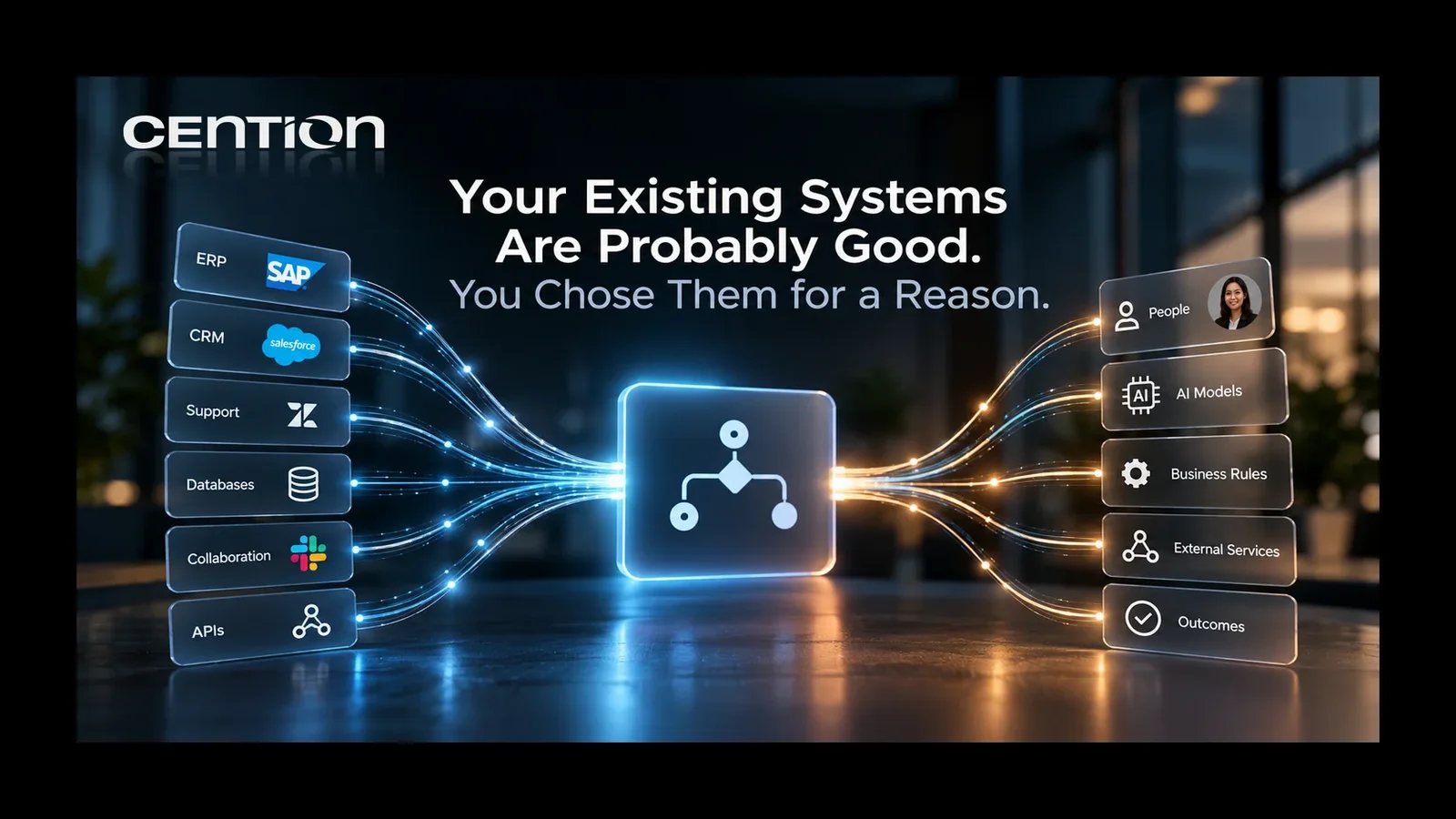
An ERP chosen because it handles finance and operations well. A CRM selected because it fits the sales process. A support platform, databases, collaboration tools, APIs and increasingly several AI services.
Those systems were not chosen by accident.
They were selected because they solved a problem, fitted a requirement or did something particularly well.
So when automation becomes a priority, the answer is not always to replace what is already there.
Quite often, the real problem is what happens between the systems.
The gaps between systems create the work
A business process rarely stays inside one application.
A customer request may begin in one channel, require data from another system, trigger a workflow, wait for an approval and eventually update an ERP or CRM.
Each system may do its own job perfectly.
The work between them is where things become difficult.
Someone copies information from one place to another. Another person checks whether an update happened. A team waits for an approval. An exception appears and nobody is quite sure where it should go.
The systems are working.
The process is still stuck.
That is an important distinction.
Integration is not the same as execution
Connecting two systems is useful.
An API can retrieve information. A webhook can trigger an action. An integration can update a record somewhere else.
But a successful integration does not necessarily mean the work is complete.
An API call can succeed while an approval is still waiting.
A workflow can finish while an exception is sitting with the wrong team.
One system can confirm that an update happened while the customer is still waiting for the actual outcome.
This is why integration and execution are not the same thing.
Integration connects systems.
Execution keeps track of the work across them and makes sure it reaches an outcome.
Keep the systems that already work
There is no reason to replace a system simply because it cannot manage the whole process by itself.
That was probably never what it was designed to do.
Your ERP should continue doing what your ERP does well.
Your CRM should continue managing customer and sales data.
Your AI models should handle the tasks they are good at.
Your existing workflow tools, APIs and business systems should continue doing what they do well.
The important question is how the work moves between them without losing context, responsibility or visibility along the way.
A good automation platform should make that possible without forcing the organisation to rebuild its technology stack around the platform.
One process can involve many participants
Modern automation is rarely one technology.
A workflow may classify an incoming request with AI, retrieve information through an API, apply a business rule, ask a person to approve an exception and then update another system.
The participants change depending on what the work requires.
What should not change is the context around the work.
At Cention, that context lives in the case.
The case keeps the participants, decisions, workflow history, actions and handovers together while the work is being executed.
A system can do its part and leave.
An AI model can contribute a decision.
A person can step in when judgement is required.
Another workflow can continue afterwards.
The case remains until the work is done.
Open architecture matters because technology changes
The systems a business uses today will not be exactly the same systems it uses five years from now.
AI models change quickly. APIs evolve. New services are introduced. Some applications are replaced while others remain for decades.
An automation architecture should be able to survive that.
If every process is tightly coupled to one model, one vendor or one workflow engine, change becomes expensive.
A more resilient approach is to let technologies participate without making the whole process depend on any single one of them.
That is why we believe openness matters.
Use the systems that make sense.
Use the models that make sense.
Use APIs, MCP, workflows, people or external services where they fit.
The execution around the work should remain stable even when the participants change.
The problem is often not the technology you already have
Many transformation projects begin with a technology discussion.
What platform should we replace?
What new system do we need?
What AI tool should we introduce?
Sometimes those are the right questions.
But often a better question is:
How do we make the systems we already have work together around the outcome we want?
That changes the conversation.
Instead of replacing applications that already work, the focus moves to the process between them: the handovers, decisions, exceptions, dependencies and ownership.
That is where a great deal of operational friction lives