
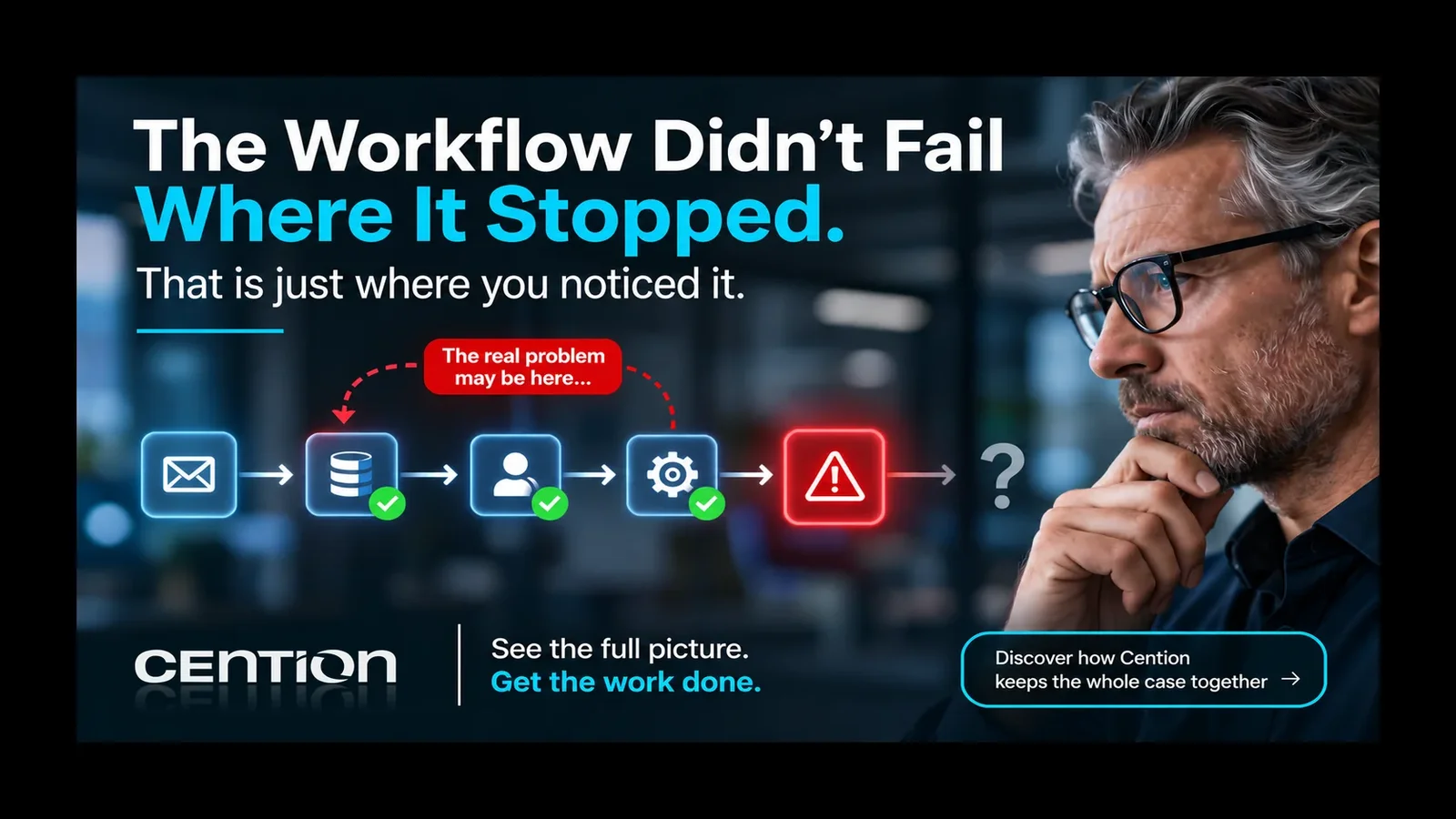
The workflow didn’t fail where it stopped. That is just where you noticed it.
The real problem may have started three steps earlier. The wrong data entered the process. An approval sat untouched. A handover lost context. A system returned something technically valid that was useless in practice.
By the time something finally turns red, you may already be looking at the end of the problem rather than the beginning.
That is one of the things that makes real automation very different from the diagram.
Most platforms can tell you where a workflow stopped. What matters in operations is understanding how the work got there.
Had anything already been completed? Was the customer informed? Did another system update successfully? Is it safe to retry? Did someone make a decision halfway through? If you restart the workflow, do you repeat something that should only happen once?
Those are the questions that appear when automation moves from a demo into the business.
Real work does not follow the diagram
On a whiteboard, processes look clean. A request comes in, the workflow runs, systems respond and the work reaches an outcome.
Reality is rarely that tidy.
A customer sends new information halfway through. An approval takes longer than expected. A system becomes unavailable. AI recommends one thing while policy requires another. Someone needs to take over. Sometimes the original workflow is no longer even the right one.
The route changes, but the work is still there.
That is why we built the new Cention around the case, not just the workflow.
The workflow describes how the work should move. The case keeps hold of the work when reality changes the route.
History, context, decisions, participants and handovers stay connected even when the process no longer follows the original path.
That sounds simple. In practice, it changes a lot.
Losing context is where things get expensive
Anyone who has worked in operations has seen this.
Something gets stuck and the next person has to work out what happened.
They open the CRM. Then the ERP. Then an email thread. Then another internal system. Then they ask someone what happened yesterday.
Twenty minutes later, they finally understand the problem they were supposed to solve.
That is where a surprising amount of time disappears.
When something needs attention, the person taking over should already know what was requested, what information was found, what actions completed, what failed, what decisions were made and what needs to happen next.
They should not have to reconstruct the process before they can continue it.
That is more than a better user experience. It is the difference between detecting a problem and recovering from one.
Cention keeps the work around the workflow
Cention does more than run workflow steps.
AI can classify, reason or recommend. APIs can retrieve and update information. Existing business systems can continue doing what they already do well. People can step in when judgement is needed.
The workflow can retry, pause, change direction or hand the work to another workflow.
The case stays with the work.
So when something goes wrong, you do not only see the failed step. You see what happened before it, what is waiting now, what has already been completed and what needs to happen next.
That is a very different level of control.
It is also where workflow automation starts becoming something you can trust with work that actually matters.
Sometimes nothing fails
There is another problem that is harder to spot.
Sometimes every technical component reports success.
The API worked. The workflow completed. The AI returned an answer.
And the customer is still waiting.
The approval never happened. The exception went to the wrong team. The final transaction was never completed.
From the system’s point of view, everything worked.
From the business point of view, it did not.
This is why we believe automation should be judged by the outcome, not simply by whether each individual step completed successfully.
Businesses do not invest in automation because they want workflows to run.
They invest because they want the work to get done.
More automation makes continuity more important
As automation becomes more capable, more work will move across AI, APIs, business systems, workflows and people without anyone watching every individual step.
That is where the real opportunity is.
It is also why context becomes more important, not less.
You need somewhere the work remains understandable from the moment it begins until the outcome is reached. Somewhere that knows what happened, who or what acted, what was decided, where the work is now and what still needs to happen.
That is what the case provides in Cention.
And when something does go wrong, you are not starting with a red box on a workflow diagram.
You are starting with the full story of the work.
The workflow didn’t fail where it stopped. That is just where you noticed it.
If your automation can tell you where something failed but not what happened around it, there is probably a gap between workflow automation and real execution.
That gap is exactly what Cention is built to close.
If you recognise that problem in your own operations, talk to us. We would be glad to show you how Cention keeps the work visible, recoverable and owned from start to finish.