
AI is impressive. It can classify, summarise, generate, recommend, retrieve information and increasingly take action. That has opened up a huge number of possibilities for automation.
But after more than two decades of building systems around real business processes, one thing has become very clear to me: AI is rarely the whole process. It is one part of it.
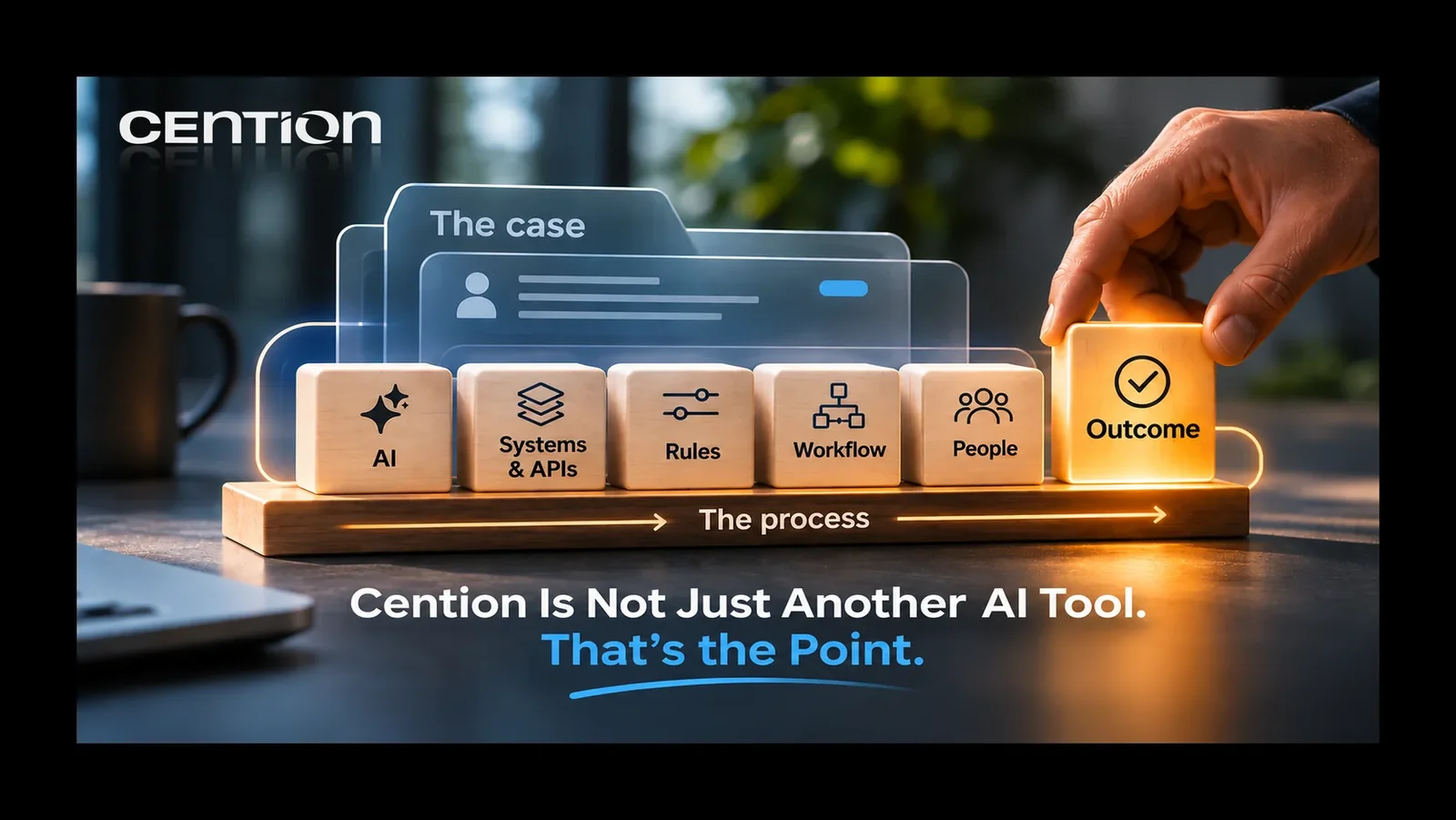
A customer request may need AI to understand what is being asked. An API retrieves information. A business rule checks whether something is allowed. A workflow decides what should happen next. A person handles an exception. Another system completes the transaction.
The AI may be the smartest participant in the process, but it still does not own the work.
That is why Cention is not just another AI tool.
The problem was never only intelligence
A lot of the current discussion around automation focuses on making the individual participant smarter: better models, better reasoning, better agents and better prompts.
Those things matter, but in my experience most operational problems are not caused by a lack of intelligence in one step. They happen between the steps.
Who acts next? What happens when an API fails? Where does the context go when a person needs to take over? What happens if an approval never arrives? What has already been completed, and can the process continue without starting again?
These are execution problems, and they existed long before generative AI arrived.
A brilliant AI response can still leave the work unfinished
Imagine an AI agent receives a customer request and understands it perfectly. It identifies the intent, retrieves the right information and recommends the correct action.
That is useful, but the job may still be far from finished.
Perhaps the action requires approval. Another system may need to be updated. The request could fall outside policy. A delivery might need to be changed in an ERP, or someone may need to confirm that a transaction actually happened.
The quality of the AI answer is only one part of the outcome.
The work is not finished until the process is finished.
That distinction becomes more important as AI is given more responsibility.
AI should be a participant, not the architecture
My view is simple: use AI wherever it creates value.
Sometimes that means classification or summarisation. Sometimes reasoning or generating a reply. Sometimes taking several actions autonomously.
But the process should not have to be rebuilt around whichever AI model happens to be best today.
Models will change. Capabilities will improve. Costs will move. New providers will appear. Some use cases will be better solved by specialised models, rules or traditional machine learning. Others may not need AI at all.
A good automation architecture should be able to use the right tool for each part of the work without making the whole process dependent on one of them.
This is where Cention is different
Cention brings workflow automation and native case management together.
The workflow controls how the work should move. The case keeps the work together while it moves.
Within that case, AI can participate alongside APIs, business systems, rules, workflows and people. If AI can complete the task, let it. If another system already has the answer, use that system. If a business rule is more predictable, use the rule. If a person needs to make the decision, bring them in with the full context already available.
The work does not need to start again every time the participant changes.
That is the part I believe is often missing.
Real automation is usually mixed
After enough years working with automation, you stop looking for one technology that solves everything.
Real processes are mixed. Some steps are highly predictable. Some depend on data. Some require judgement. Some need empathy. Some need an API. Some can be handled by AI. Some should absolutely remain with a person.
The job is not to maximise the amount of AI in the process.
The job is to get the work done reliably.
That often means combining several technologies rather than forcing everything through the latest one.
The case gives the work continuity
One of the reasons we built Cention around the case is that processes do not always follow a clean diagram.
Things change. A customer replies with new information. A system fails. An exception appears. A workflow needs to pause. A person needs to intervene. A different workflow needs to continue.
The case preserves the context around all of that. It keeps the history, participants, actions, decisions and current state of the work together.
That allows the technology underneath to change without losing the continuity of the process.
For me, that is a much more durable foundation than building automation around one model or one type of agent.
We use AI. We just do not confuse it with the whole solution.
Cention has AI capabilities throughout the platform, and we use AI where it makes sense.
We also support external models where they make more sense. We use rules where predictability matters, APIs where systems already know the answer, and people where judgement, accountability or experience is required.
There is no ideological preference for one participant over another. The process should use what works.
What Cention provides is the execution around them: one place where the work can start, move, change, escalate and eventually reach an outcome.
That is what I believe enterprise automation needs.
Not another isolated AI tool or another agent that performs one impressive task, but a way to make AI, people and systems work together around real business outcomes.
Cention is not just another AI tool. That’s the point.
If you are looking at how AI fits into your wider automation architecture, rather than treating AI as the architecture itself