
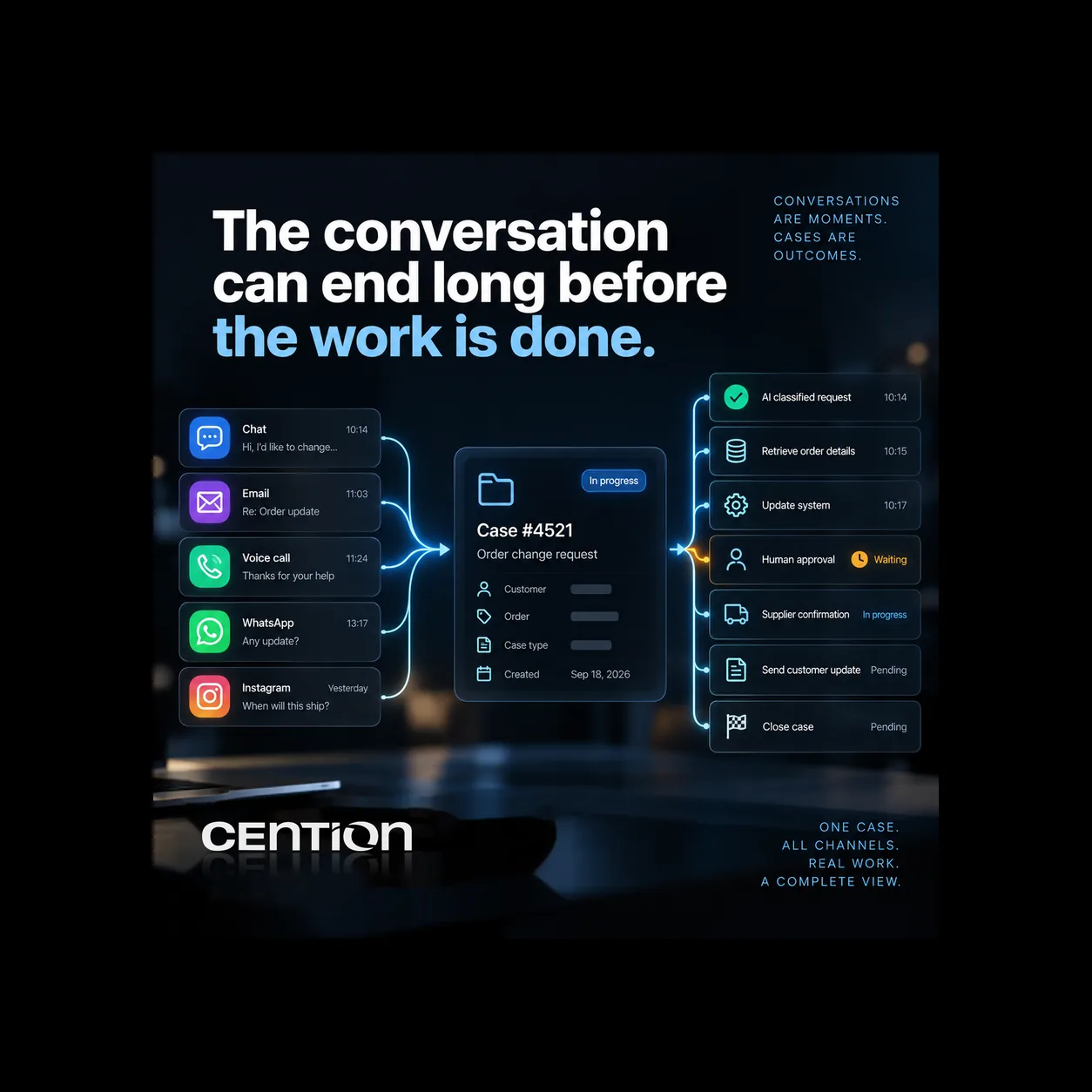
A customer gets an answer in chat. An email thread is closed. A call ends.
From a communication perspective, the interaction is finished.
But the work behind it may have only started.
A refund still needs approval. An order needs changing. A supplier has to respond. An account needs updating. A compliance check needs completing. AI, workflows, business systems and people may all become involved before there is an actual outcome.
That is why we believe a conversation and a case are two very different things.
Conversations are moments
A conversation is an interaction.
It may happen over chat, email, voice, WhatsApp, social media or another channel. It can be short or long, simple or complex, and it may resolve part of the customer’s question immediately.
But a conversation only shows one moment in the life of the work.
The actual business process may continue long after the interaction ends.
A customer may receive a response while an internal approval is still pending. A support agent may close a chat while another department needs to investigate an exception. A supplier may need to confirm something before the case can move forward. Another conversation may start the next day through a completely different channel.
If each conversation is treated as a separate object, the context fragments quickly.
The case keeps the work together
For us, the case is the place where the complete piece of work lives.
It keeps the context, the decisions, the participants, the workflow history, what has already happened and what still needs to happen.
The conversation is one part of that.
So is the AI model that classified the request. So is the ERP system that provided information. So is the workflow that routed the next step. So is the human who approved an exception. So is the supplier or external API that completed another part of the process.
All of them contribute to the same case.
That means the business does not have to reconstruct the story across channels and systems every time someone needs to understand what is happening.
The case already holds the state of the work.
Channel changes should not reset the context
Customers do not think in channels.
They may start in chat, follow up by email, call later and eventually respond through WhatsApp.
From their perspective, it is still the same issue.
The technology should treat it the same way.
A new interaction should not create a new version of the problem simply because the channel changed. It should become part of the same ongoing case whenever it belongs to the same piece of work.
That becomes especially important when automation and AI are involved.
If an AI model already classified the request, a workflow already retrieved the relevant data and a human already made a decision, the next interaction should not start from zero.
The context should continue with the work.
Closing the conversation is not the same as completing the case
This distinction matters because many systems are still designed around interactions.
A chat closes. An email thread is resolved. A call ends.
Those events are useful operational milestones, but they are not necessarily business outcomes.
A case should remain open until the work itself reaches a meaningful conclusion.
That may mean the order was changed, the refund was approved, the investigation was completed, the customer was notified or the exception was resolved.
The important thing is not that the communication ended.
The important thing is that the work reached an outcome.
The case becomes the durable context
As more participants become involved in business processes, preserving context becomes increasingly important.
People change. AI models change. Workflows evolve. Systems are replaced. New channels appear.
The case provides continuity across all of that.
It becomes the durable record of what happened, who participated, which decisions were made, what is still outstanding and how the work finally concluded.
That is why we do not see case management as something limited to customer service.
It is simply a practical way of keeping work together until it is done.
The interaction ends when the conversation stops. The case ends when the work is done.