
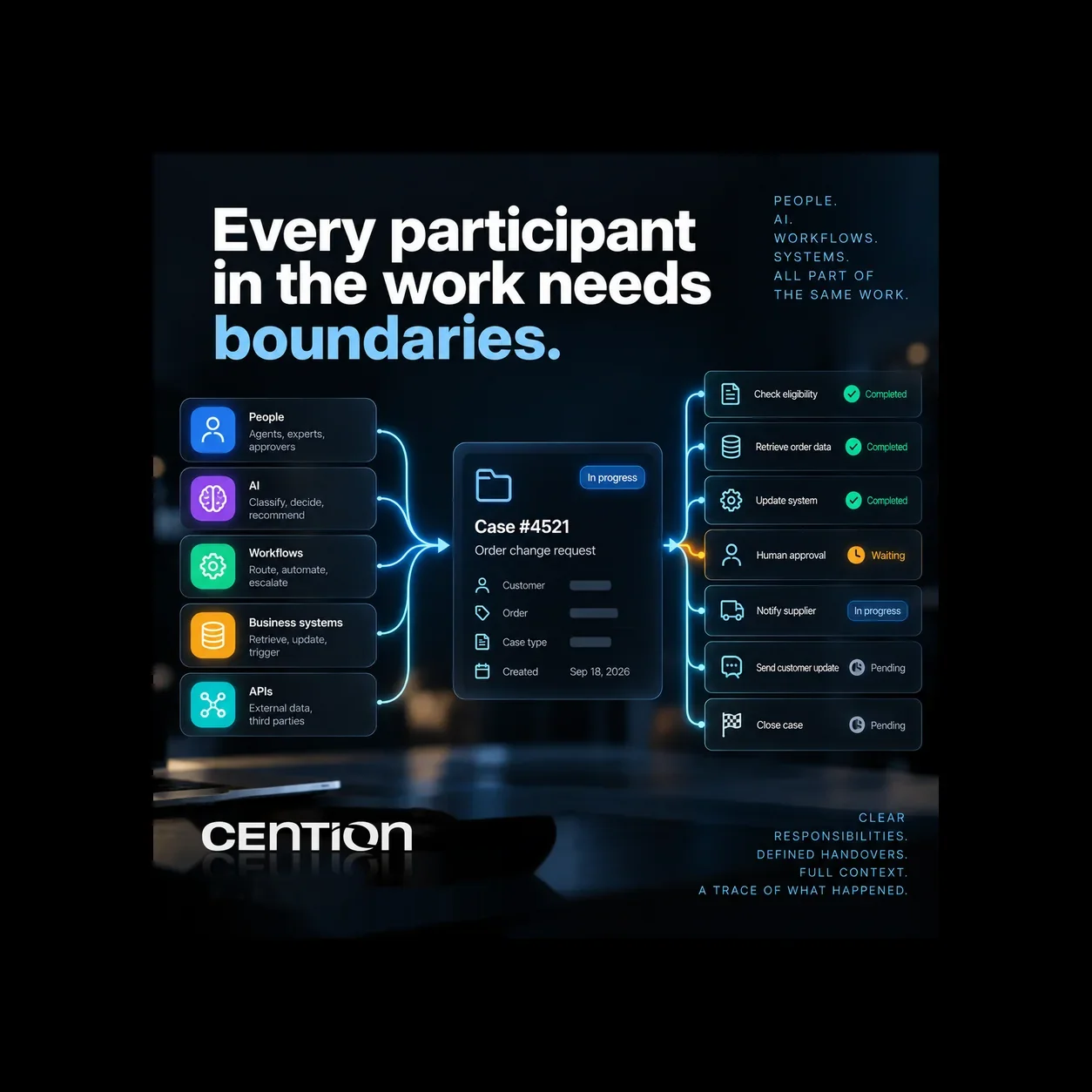
Modern business processes involve more participants than ever before.
People make decisions. AI classifies, recommends and sometimes acts. Workflows move the process forward. APIs connect external services. Business systems retrieve or update information. Partners and specialists may become involved along the way.
All of them can influence the outcome.
That is why we believe every participant in the work needs clear boundaries.
The question is not only what a participant can do. It is where that responsibility starts, where it ends, and what should happen when the next participant needs to take over.
Responsibility needs to be explicit
A human approver may be allowed to make one kind of decision but not another. An AI model may classify a request or recommend an action, but perhaps not complete the final transaction. A workflow may route and escalate work, while an external API is only responsible for providing data.
Those boundaries matter because modern execution is shared.
If responsibilities are not clear, automation quickly becomes harder to control. The same is true for human processes. Work gets delayed, exceptions fall between teams, and nobody is quite sure who owns the next step.
Clear execution means being able to answer a few simple questions.
What was this participant allowed to do? What information did it use? Which decisions could it make on its own? When should someone else become involved? And what happened afterwards?
Governance should be part of the execution
Governance is often discussed as something separate from the work itself: policies, permissions, reviews and controls that sit around the process.
We think it should be much closer to the execution.
The responsibilities of each participant should be part of how the workflow is designed and how the case is handled. Handovers should be defined. Actions should become part of the same context and history. When something changes state, the business should be able to understand who or what caused it.
That applies whether the participant is a person, an AI model, a workflow, an API or another business system.
The principle is the same.
The more authority a participant has, the clearer its boundaries need to be.
Handovers matter as much as individual actions
Most execution problems do not happen because one participant completely failed.
They often happen at the boundaries between participants.
A workflow completes its step, but the human approval never happens. An AI model produces the right result, but the next system does not use it correctly. An API returns information, but nobody handles an exception in that response. A person completes a task, but the rest of the process is not updated.
The individual action may have been correct.
The handover was not.
That is why defined handovers are so important. The process should know what happens next, who becomes responsible, what context needs to move with the work and what should happen if the expected handover does not occur.
Good execution is not just a collection of successful actions. It is a chain of responsibilities that remains intact from beginning to end.
The case keeps the boundaries visible
At Cention, we see the case as the common context around that execution.
The case keeps track of who participated, what happened, which decisions were made, what is still waiting and who needs to act next.
That makes responsibilities visible across the process instead of leaving them hidden inside individual systems or workflows.
If AI makes a decision, it becomes part of the case history. If a human approves an exception, that becomes part of the same history. If an API updates an external system or a workflow escalates the work, those actions remain connected to the same outcome.
The technology performing the work may differ.
The accountability should not.
More automation requires clearer boundaries
As businesses automate more, they introduce more participants into their processes.
That can increase speed and remove repetitive work, but it also creates more places where responsibility needs to be understood.
The solution is not to reduce automation. It is to make the execution clearer.
Who can act? Who can decide? Who can approve? When should work be handed over? What happens when the expected path breaks?
When those boundaries are explicit, businesses can automate more confidently without losing control of the work.
The more authority we give a participant, the clearer its boundaries need to be.