
Modern business processes rarely live inside one system.
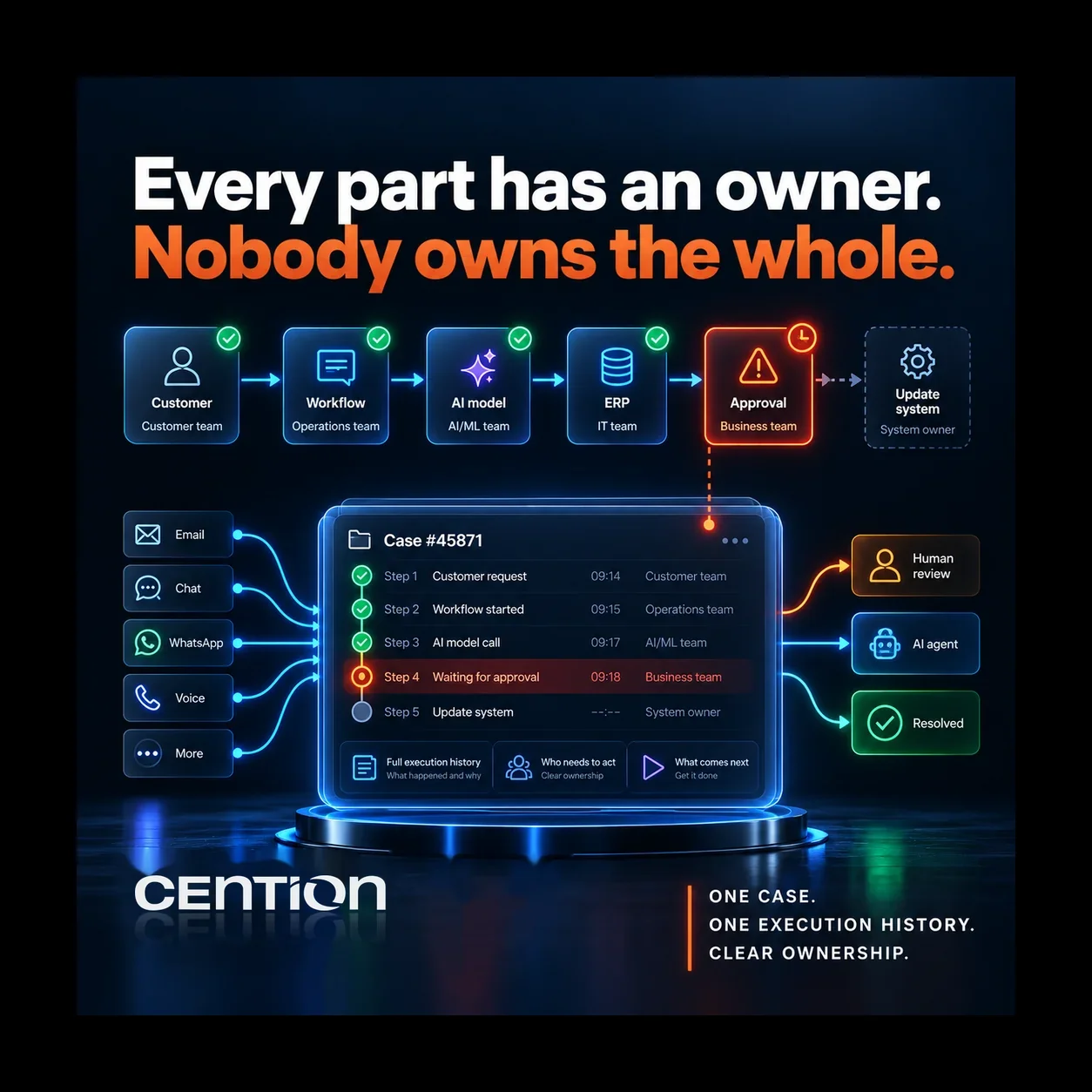
A piece of work may start with a customer, an employee or another system. It triggers a workflow, calls an AI model, retrieves data from an ERP, waits for approval and then updates another system.
Each individual part may have an owner.
The workflow belongs to one team. The ERP belongs to another. The AI model may be managed somewhere else. The approval sits with a business function.
And yet the overall work can still end up without a clear owner.
That is where things become difficult.
The problem usually is not a missing tool
When a process stops halfway through, the first instinct is often to look for another system or another automation.
But the issue is often not that the business lacks tools.
It is that responsibility is fragmented across too many of them.
One system says the API succeeded. Another says the workflow completed. The AI step ran as expected. Someone is still waiting for an approval.
Technically, several parts may be working correctly.
And the work is still not done.
That is the gap between managing individual components and managing execution from beginning to end.
Ownership has to survive the handovers
Most real work moves across teams and systems.
That means ownership cannot disappear every time the process crosses a boundary.
If one step fails, the business should be able to answer a few simple questions immediately:
What already happened?
What is waiting?
Who needs to act?
What failed?
What comes next?
And can the work continue without starting again?
Those questions sound simple, but they become surprisingly hard to answer when every participant only sees its own part of the process.
This is what the case is for
At Cention, we built the case to provide that common execution context.
The case is not just a record of the request. It holds the complete history of the work as it moves across workflows, AI, APIs, business systems and people.
If step 3 of 5 fails, you should not have to reconstruct the process from several different logs and systems before you can understand what happened.
You should be able to open the case and see the execution history in one place.
What has already completed. What is still waiting. Who is responsible. What needs to happen next.
That is what turns a collection of automated steps into accountable execution.
One owner does not mean one person
Ownership does not mean a single employee manually controlling every process from start to finish.
It means the work itself has a clear state, a clear history and a clear path forward.
Different participants can still own individual steps. AI can act where it makes sense. A workflow can automate routine decisions. A business system can update information. A person can step in when judgement is required.
But all of those contributions belong to the same piece of work.
The ownership of the outcome does not disappear just because the execution is distributed.
The more automation you add, the more important this becomes
Automation increases speed and reduces manual effort. But it also increases the number of participants, dependencies and handovers inside a process.
That makes fragmented ownership more dangerous.
A process can become highly automated and still be difficult to manage when something unexpected happens.
The goal should not only be to automate more steps.
It should be to make sure the work remains visible, accountable and moving toward an outcome from beginning to end.
That is the problem Cention is built to solve.
Every workflow needs an owner. Cention keeps that ownership visible from start to finish.