
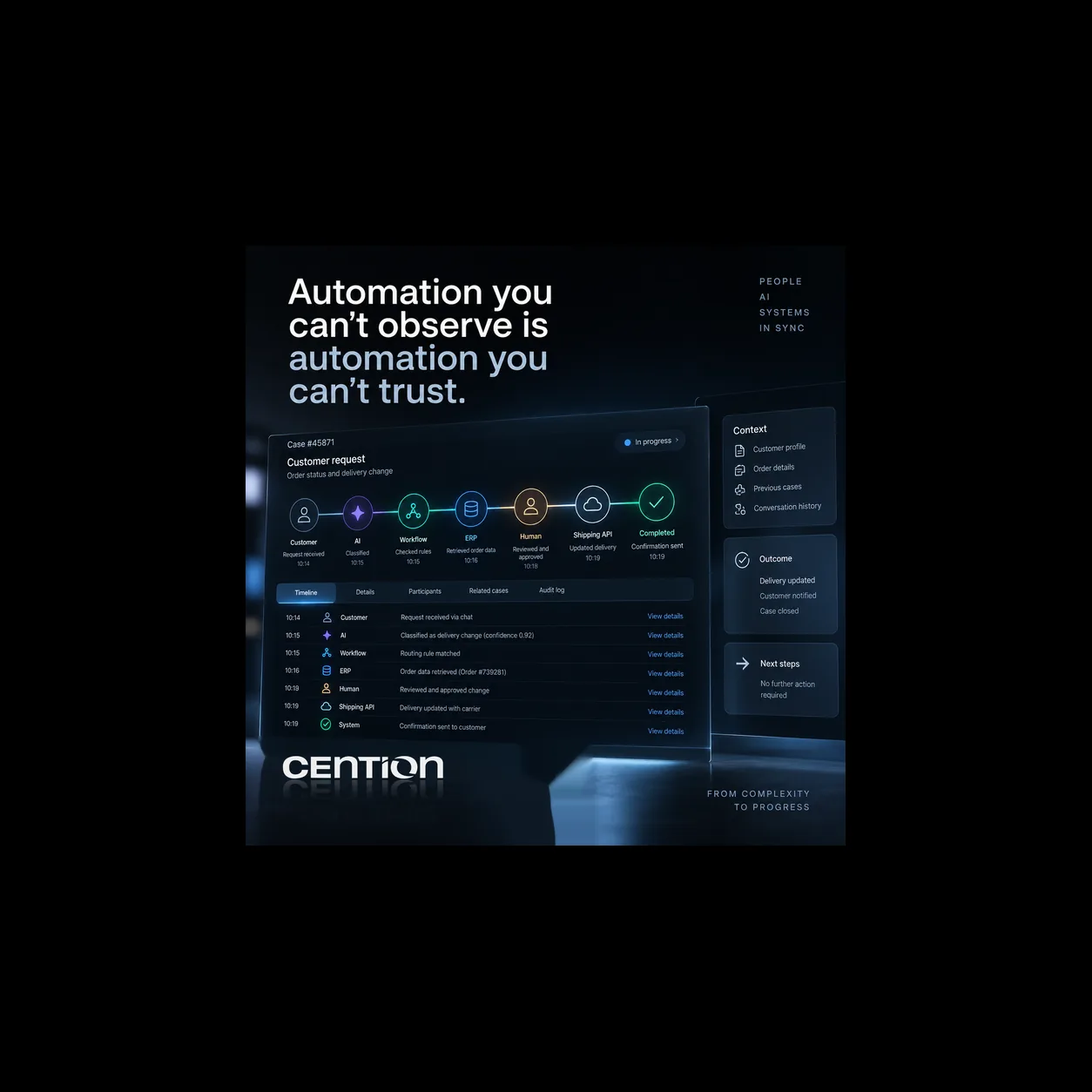
As more work moves between AI, workflows, APIs and business systems, it becomes increasingly easy to automate something without really knowing what is happening inside it.
When everything works, that may not seem like a problem. The workflow starts, the systems respond, the process completes and the customer gets the expected outcome. But the real test of automation is not what happens when everything goes right. It is what happens when something does not.
Which step failed? What had already happened? Which system responded? What did the AI decide? Was a human involved? What is still waiting, and can the work continue without starting again?
Those questions become much more important as automation spreads across different technologies. A process may include an AI model, an ERP system, an external API, a workflow engine and a human approval. Each part can work exactly as designed and the overall process can still fail.
An API may return the correct information but the next step never runs. An AI model may classify something correctly, but the workflow sends it in the wrong direction. A business system may become temporarily unavailable halfway through a transaction. A human may need to step in to handle an exception that nobody anticipated.
In all of those situations, the business still has work that needs to be completed.
That is why we believe observability is not just a technical monitoring function. It is part of execution.
Knowing what happened is not enough
Traditional monitoring often focuses on individual systems. Is the service running? Did the API respond? How long did the request take? Did the workflow complete?
Those are useful questions, but they do not always tell you whether the work itself was completed correctly.
A business process crosses boundaries. It may start with a customer, move through an AI model, call an external system, wait for a person and then return to automation. Looking at the logs from each individual component can tell you what happened inside that component, but it does not necessarily tell you the story of the work from beginning to end.
For us, that complete story belongs in the case.
The case should show which participants were involved, what decisions were made, what information was used, what happened before and after each step, and what still needs to happen. That creates a common execution history rather than a collection of disconnected technical logs.
Every participant should leave a clear trace
As AI becomes another participant in business processes, traceability becomes even more important.
If an AI model classifies a request, that should be visible. If a workflow makes a routing decision, that should be visible. If an ERP provides data, if a human approves an exception or if an external API completes a transaction, those actions should become part of the same execution history.
The goal is not to record everything simply because we can. The goal is to make the process understandable.
If something goes wrong, the person investigating should not have to reconstruct the process across several systems before they can even begin to solve the problem. They should be able to see the state of the work, understand what has already happened and continue from there.
That matters operationally, but it also matters for accountability. When automation becomes responsible for more of the work a business performs, “it failed somewhere” is not a sufficient explanation.
Observability should help work continue
There is another reason we see observability as part of execution rather than something separate from it.
Knowing that a workflow failed is useful. Knowing what to do next is more useful.
If an external system is unavailable, should the workflow retry later? If an AI result is uncertain, should the case be sent to a human? If a required approval has not happened, who should be notified? If part of the process completed successfully before the failure, can the workflow continue from that point rather than starting again?
These are execution questions.
Good observability should make it possible to understand the current state of the work and decide what happens next. That can mean automated recovery, escalation to a person or simply making enough context available for someone to continue without repeating everything that came before.
The objective is not to build a perfect dashboard of technical events.
The objective is to make sure the work gets done.
Automation becomes more valuable when it becomes understandable
As companies introduce more AI and automation, the number of technologies participating in a single business process will continue to grow. Models will change. Systems will be replaced. Workflows will evolve. New APIs and new forms of automation will appear.
That makes execution visibility more important, not less.
The individual technology may change, but the business still needs to understand what happened, why it happened and what should happen next.
At Cention, that is why we see observability, workflow execution and case management as parts of the same problem.
If the work matters, the execution needs to be visible.