
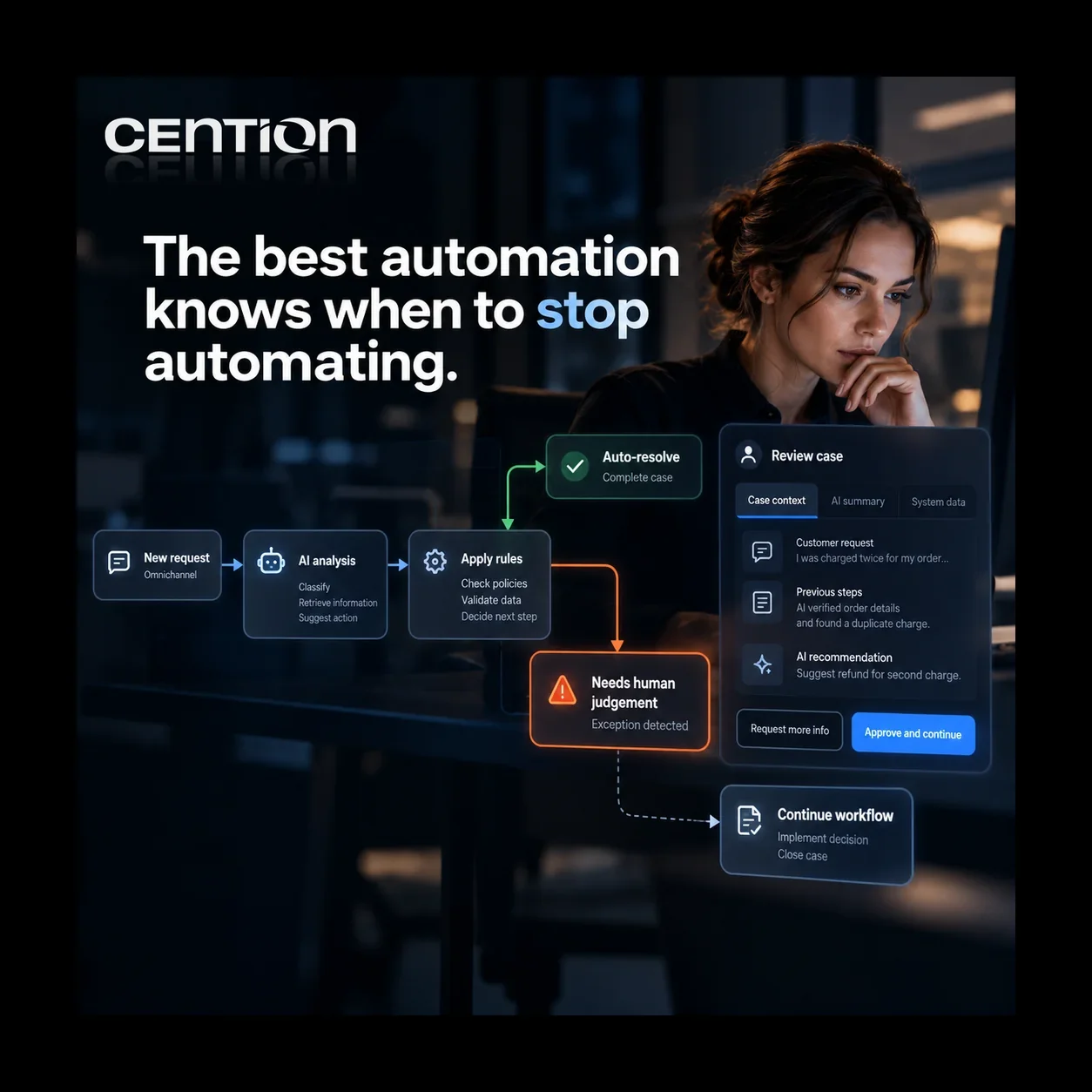
Most business processes are predictable until they aren’t.
A workflow can handle the routine path. AI can classify a request, retrieve information and recommend an action. Business rules can decide what happens next. When everything fits the expected pattern, automation can move the work forward quickly and consistently.
The challenge starts when reality does not fit the model.
Information conflicts. A customer situation falls outside the normal pattern. A business rule does not cover the case. The confidence level is too low. The financial or operational risk is too high for an automated decision.
That is not a failure of automation.
It is the point where human judgement becomes part of the process.
Human-in-the-loop should not mean starting over
Many automation projects handle exceptions badly.
The automated process runs until it reaches something unusual. Then the work is handed to a person with little more than a notification that something needs attention.
The human has to reconstruct the situation.
What happened before the exception? Which systems were checked? What information was found? What did the AI recommend? Which rules were applied? Why was the work escalated?
That creates exactly the kind of manual effort automation was supposed to reduce.
For us, human-in-the-loop automation should work differently.
When a person becomes involved, the case should already contain the context they need to make the decision. The previous actions, system data, AI recommendations, business rules and reason for escalation should all remain connected to the same piece of work.
The person makes the decision.
Then the workflow continues from where it stopped.
The exception path matters as much as the happy path
It is relatively easy to demonstrate automation when everything goes according to plan.
The more important question is what happens when it does not.
A well-designed workflow should know when it can continue automatically and when it needs help. That may depend on confidence thresholds, business rules, risk levels, missing information or conditions that simply require judgement.
The important thing is that the exception does not break the execution.
If a human approval is required, the work should pause in a known state. The right person should receive the case with the full context. Once the decision is made, the workflow should resume without repeating the steps that already completed successfully.
That is what turns human review from a manual interruption into part of the workflow itself.
AI and people are good at different things
There is a tendency to measure automation success by how many people can be removed from a process.
We think that is the wrong objective.
AI and automation are very good at repetitive tasks, classification, information retrieval, pattern recognition and applying predictable rules at scale.
People are better at ambiguity, judgement, negotiation, unusual situations and decisions where the consequences matter.
The strongest process does not force one participant to do everything.
It uses the right participant for each step.
Sometimes that is AI. Sometimes it is a workflow or business rule. Sometimes it is an API. And sometimes it is a person.
The important thing is that they all participate in the same execution, with the same context around the work.
The case keeps the handover intact
This is where case management becomes important.
The case provides the persistent context around the workflow. It holds what has happened, which participants were involved, what information was used, which decisions were made and what still needs to happen.
So when automation reaches the point where human judgement is required, the handover does not create a new process.
It is simply the next step in the same case.
The human can understand why the work reached them, make the required decision and return control to the workflow.
That makes the process easier to operate, easier to audit and much easier to improve over time.
Good automation knows its limits
The goal is not to automate every possible decision.
The goal is to automate the work that should be automated while making the exceptions clear, controlled and easy to resolve.
That becomes increasingly important as businesses introduce more AI into operational workflows. The more capable AI becomes, the more important it is to define when it should act independently and when human judgement should take over.
Automation becomes more valuable when it knows its limits.
Good automation does not remove people from the process. It makes sure they are involved where their judgement adds the most value.