
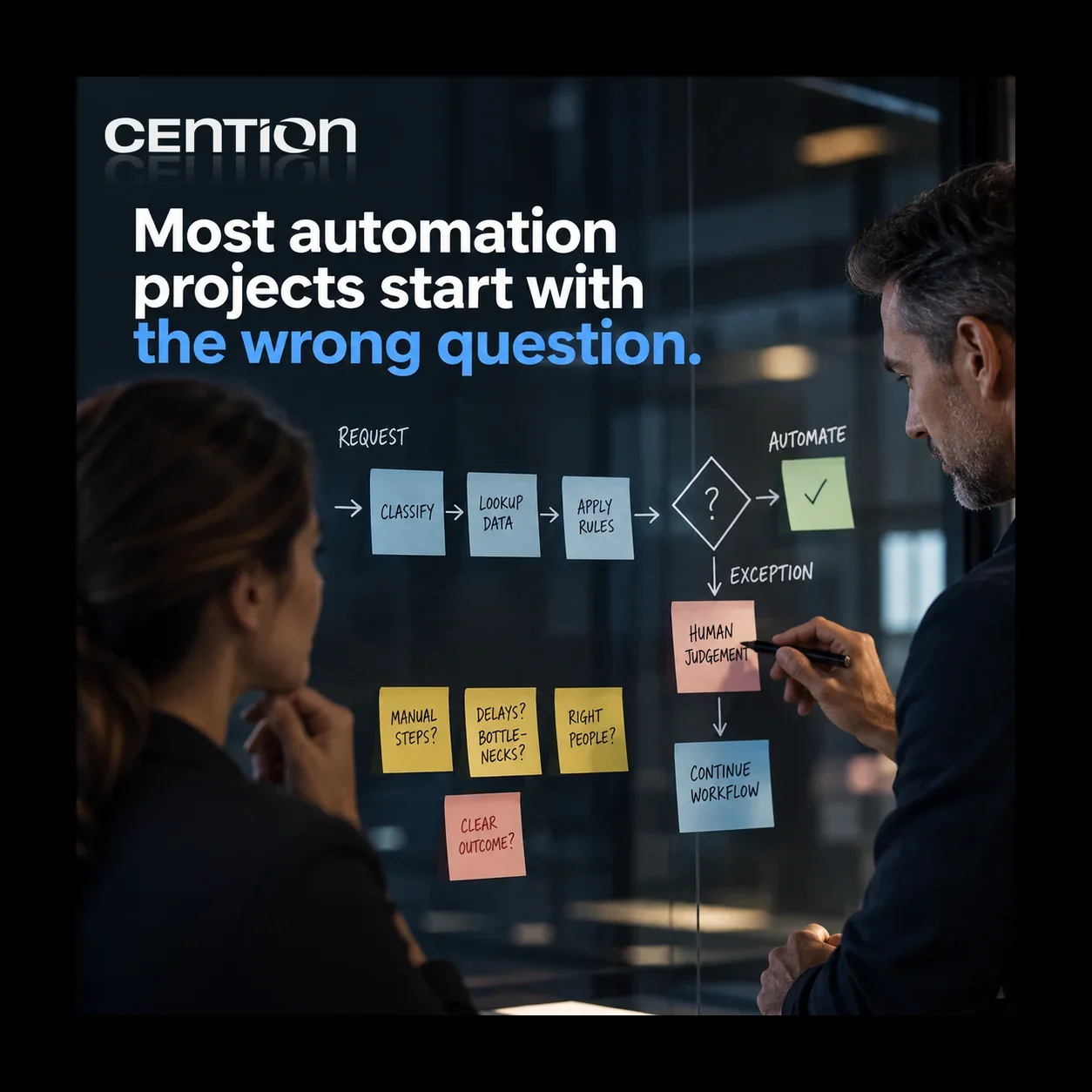
Most automation projects begin with the same question:
What can we automate?
With today’s technology, the answer is usually: quite a lot.
AI can classify information, extract data, recommend actions and make decisions. APIs can connect systems. Workflows can coordinate steps. Business rules can handle predictable situations. People can be brought in when judgement is required.
The problem is that starting with the technology often leads to automating the wrong thing.
A better place to start is with the work itself.
What is consuming time? Where are people searching, copying, waiting or chasing? Which parts are predictable? Where do exceptions occur? Which systems are involved? And most importantly, what outcome tells you the work is actually finished?
Those questions usually lead to much better automation.
Start with the work, not the tool
A process may already involve several systems and teams before anyone introduces new automation.
A customer request comes in. Someone looks up information. Another person checks a rule. A third team approves something. An ERP is updated. A confirmation is sent.
From the outside, it may look like one simple task.
Inside the business, it can be a chain of handovers, repeated lookups and manual decisions.
That is where the opportunity is.
The goal should not be to automate every visible step. It should be to understand where effort is being spent and where delay or friction is being created.
Sometimes the best improvement is AI.
Sometimes it is a simple business rule.
Sometimes it is an API call.
Sometimes it is better routing.
Sometimes the right answer is to leave a decision with a person.
The technology should follow the process, not the other way around.
Look for repeated work and bottlenecks
The easiest automation opportunities are often already sitting on the team’s to-do list.
Order lookups. Return requests. Booking changes. Approvals. Customer updates. Internal exceptions. Data checks. Repetitive administrative work.
These are useful places to start because the process already exists and people already understand where it causes problems.
The first question should be:
Where does this work slow down or require unnecessary effort?
Maybe information is spread across several systems. Maybe the same data is copied from one place to another. Maybe a person spends time checking something that could be retrieved automatically. Maybe an exception sits unnoticed until someone asks for an update.
Those are practical automation problems.
And they are usually easier to solve than trying to design an “AI strategy” in the abstract.
Define the outcome before you automate
Automation is much easier to measure when the desired outcome is clear.
What does “done” actually mean?
The customer received the correct answer? The refund was approved? The order was updated? The case was closed? The internal system reflects the final decision?
Without a clear outcome, it is easy to automate individual steps while leaving the overall process unresolved.
That is why we believe the case matters.
The case provides a common context around the work and makes it possible to see whether the process is actually moving toward completion, not just whether individual workflow steps ran successfully.
Use the right participant for each step
Once the work is understood, the technology choices become much easier.
AI can handle classification, summarisation, extraction or recommendations.
Business rules can manage predictable decisions.
APIs can retrieve or update information.
Workflows can coordinate the sequence.
People can handle ambiguity, judgement or approval.
The strongest automation does not try to force one technology into every part of the process.
It uses the right participant for each step and keeps the work connected from beginning to end.
Start small, then expand
A successful automation project does not need to begin with a large transformation programme.
Start with one piece of work your team repeats every day.
Map the steps. Identify the bottlenecks. Decide what can be automated safely. Keep human judgement where it adds value. Define the outcome clearly.
Then make that one process work well from start to finish.
Once that works, expand.
That approach usually creates value faster and gives the business something much more useful than a collection of disconnected automations.
The goal is not to automate as much as possible.
The goal is to get the work done with less effort, fewer delays and clear ownership from start to finish.