
Most businesses already have plenty of automation.
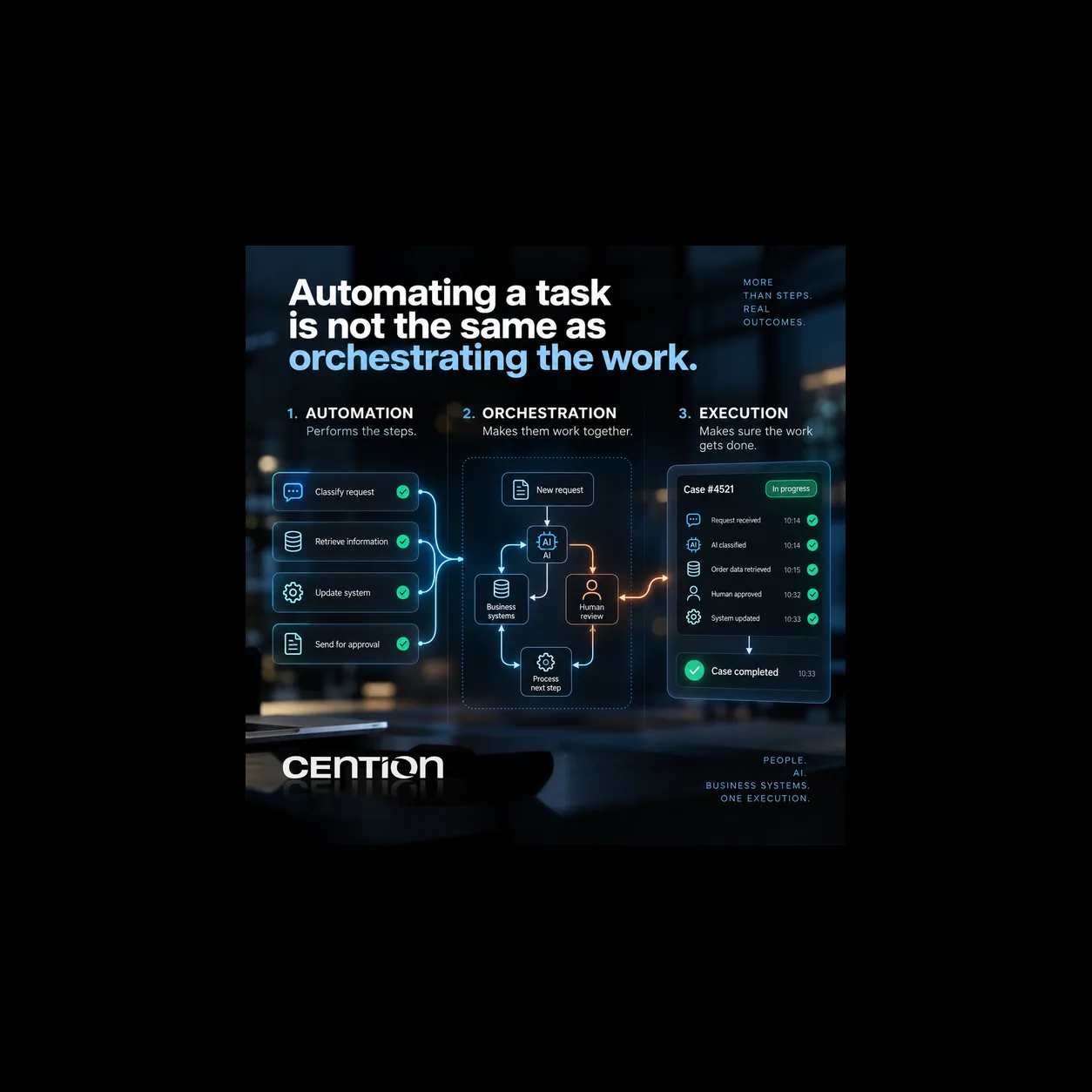
An AI model classifies a request. An API retrieves information. A workflow updates a system. A rule sends something for approval. Individually, each step may work exactly as intended.
The harder part is making all of those steps work together.
That is where orchestration becomes important.
A business process rarely runs inside one system from beginning to end. It may involve AI, internal applications, external APIs, workflow logic and people. Each participant has a role, but the outcome depends on how well they are coordinated.
The question is not only whether every individual step can be automated. It is whether the work continues to move forward as the process crosses systems, technologies and teams.
Automation handles the steps
Automation is usually focused on a specific task.
Classify this request. Retrieve this information. Update this record. Send this approval. Trigger this action.
These automations can save significant amounts of time and remove repetitive work. They are essential building blocks.
But they are still building blocks.
A successful API call does not guarantee that the next step happens. An AI decision can be correct while the overall process moves in the wrong direction. A workflow can complete one stage successfully while the work waits somewhere else for hours or days.
That is why successful automation is not necessarily the same thing as successful execution.
Orchestration coordinates the work
Orchestration is about how those individual capabilities work together.
What happens first? Which step depends on something else? When should AI make a decision, and when should a person become involved? What happens if an external system is unavailable? Should the process wait, retry, escalate or take another route?
These are not isolated automation questions. They are questions about the process as a whole.
For us, orchestration is not simply about connecting more boxes on a workflow diagram. It is about coordinating people, AI and business systems around the outcome the business is trying to achieve.
That requires context.
If an AI model hands work over to a person, the person needs to understand what has already happened. If an API fails halfway through the process, the workflow needs to know which steps completed successfully. If an exception requires a different route, the process should not lose the decisions and information that brought it to that point.
Good orchestration keeps that context intact while the work moves between participants.
But orchestration is still only part of the picture
Even a well-orchestrated process can encounter something unexpected.
A human approval may never happen. A system may return something nobody planned for. A workflow may reach an exception that has no predefined path. The technology may have done exactly what it was designed to do, while the business outcome is still unresolved.
At that point, someone still needs to know what is happening.
What has already been completed? What is waiting? Who needs to act? Has something exceeded its SLA or deadline? What should happen next?
That is where execution becomes different from orchestration.
At Cention, we see execution as the layer that keeps the state of the work together until there is an outcome. The case provides the common context around the process, while workflows, AI, APIs, business systems and people participate in getting the work done.
The individual steps matter. The orchestration matters. But neither is the final objective.
The outcome is.
From automation to orchestration to execution
The distinction is simple:
Automation performs the steps.
Orchestration makes them work together.
Execution makes sure the work gets done.
That is increasingly important as businesses introduce more AI and automation into their operations.
More automation means more participants, more dependencies and more possibilities for something to happen outside the expected path. Connecting those technologies is useful. Coordinating them is better. But the business still needs a place where the work remains visible, accountable and moving toward an outcome.
That is the role we believe execution should play.