
When companies look at enterprise software, they often feel they have to make a choice.
Either they buy a complete platform and accept that they will eventually have to adapt their business to it, or they build their own solution by connecting a number of best-of-breed products together.
Neither option is ideal.
The first can lead to vendor lock-in. The second often creates a growing collection of technologies that all need to be maintained, monitored and kept in sync.
We don’t think businesses should have to choose between those two extremes.
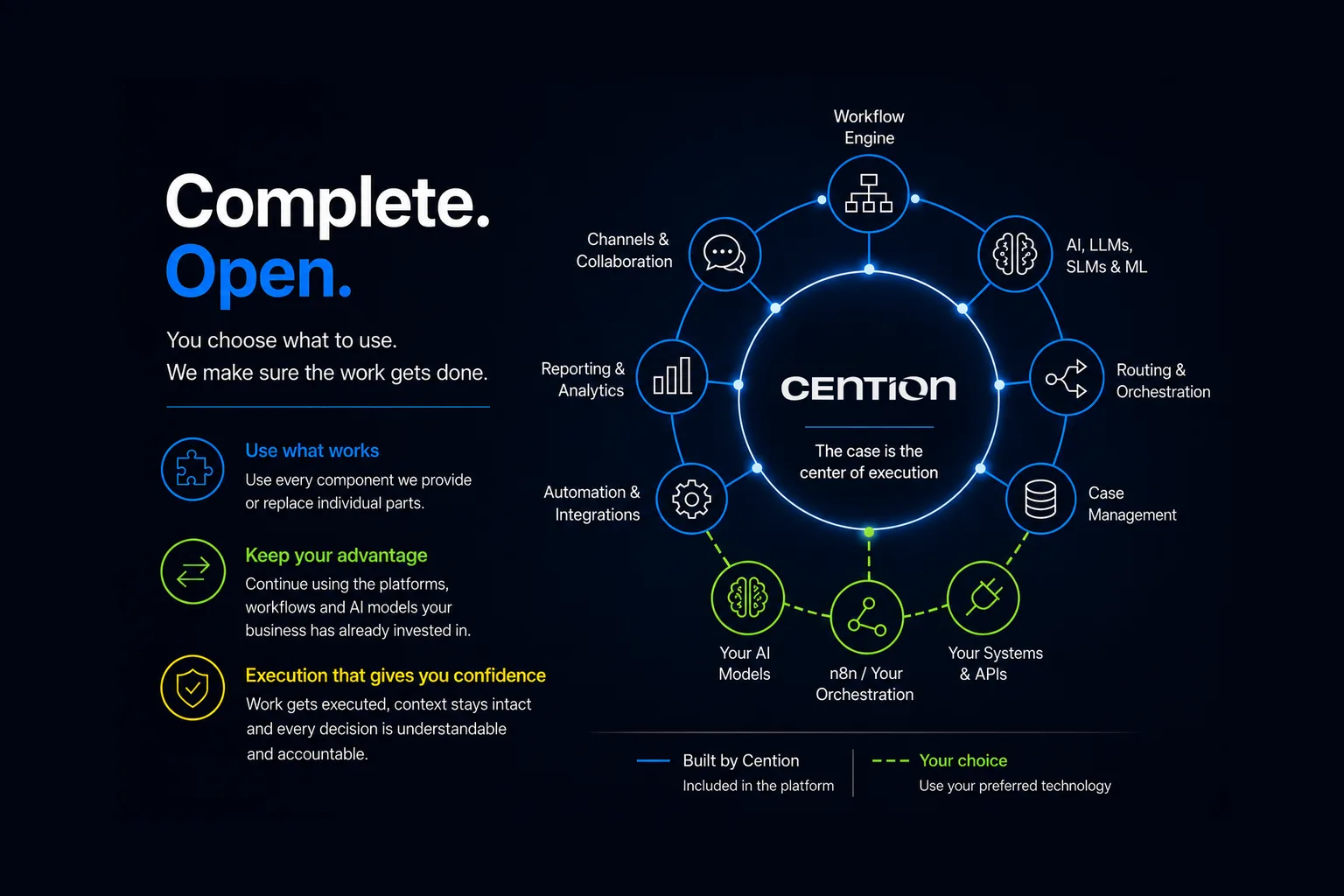
At Cention, we’ve built workflow orchestration, automation, AI, LLMs, SLMs, machine learning, routing, reporting and case management because we believe those capabilities belong together. For many businesses, that’s everything they need to automate, execute and follow up on work.
At the same time, we also know that every business is different.
Some have already invested heavily in another orchestration platform. Others have standardized on specific AI models or built integrations that represent years of development. Those investments shouldn’t lose their value simply because a new platform is introduced.
That’s why we don’t see external technologies as competitors to replace. We see them as participants in the same case.
A workflow might execute inside Cention. It might execute in n8n. It might call your own APIs, use your existing business logic or rely on AI models you’ve already chosen. From the perspective of the case, it doesn’t really matter.
What matters is that the work gets done.
The case keeps the context. It records what happened, who participated, what decisions were made and why. The technologies involved are free to evolve over time without losing the history behind the outcome.
That approach gives businesses much more freedom.
You can start by using every capability Cention provides. Later, if a better AI model appears, you can adopt it. If your orchestration strategy changes, you can change that too. If you decide to build something unique for your business, it becomes another participant rather than something that sits outside the process.
The goal has never been to make customers dependent on our technology.
The goal is to make sure the execution of work remains reliable, understandable and accountable, regardless of which technologies are involved.
Technology will continue to change.
Your ability to execute work shouldn’t have to change with it.