
If you’ve followed the rapid development of AI over the last few years, you’ve probably noticed how quickly the conversation changes. A new model is released, a new workflow framework appears, another orchestration platform is launched, and suddenly everyone is discussing whether they should rebuild what they created only a few months ago.
That pace of innovation is exciting, but it also has an interesting side effect. Businesses often spend a lot of time deciding which technologies should participate in a workflow, while spending far less time thinking about how that workflow should be managed once those technologies start working together.
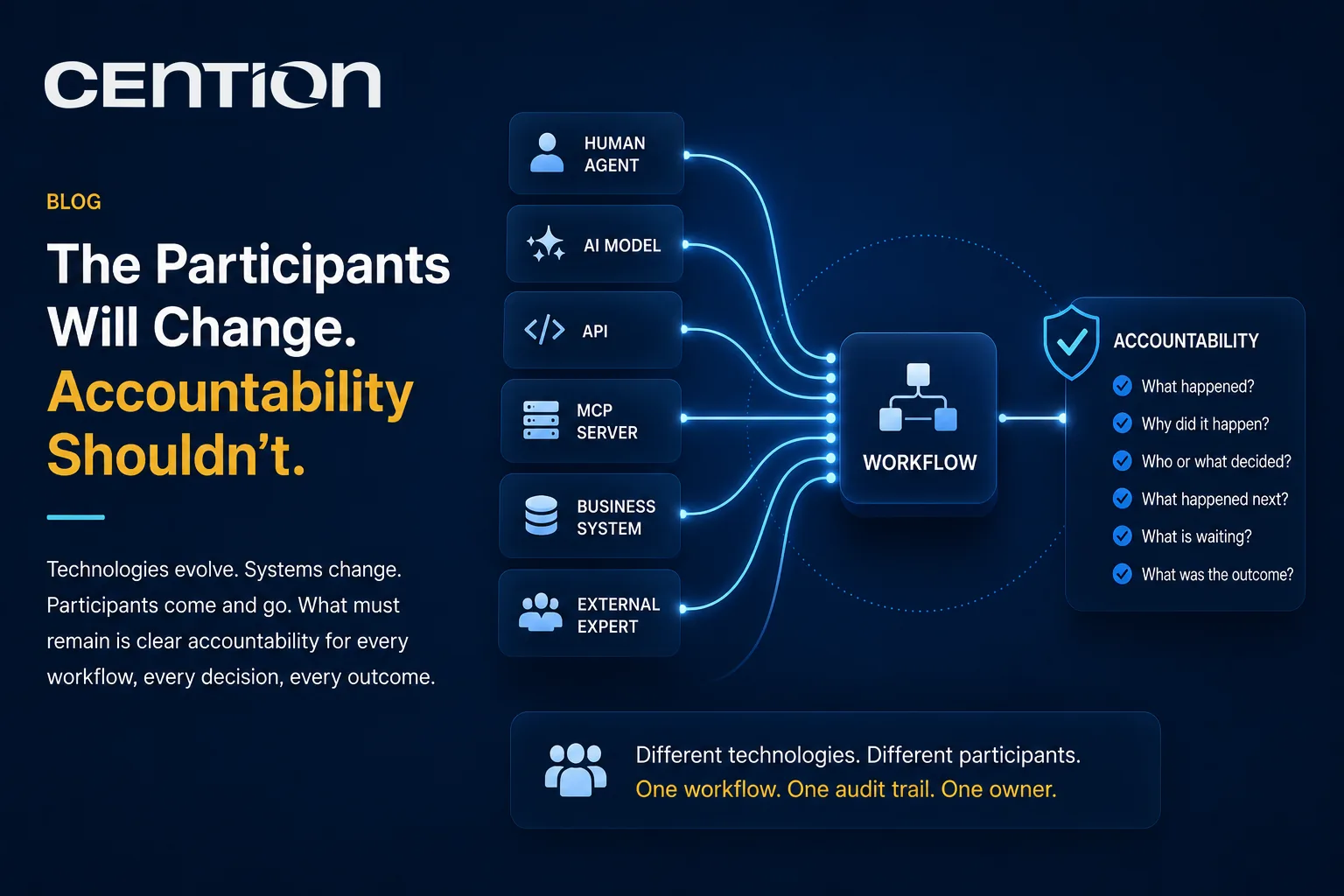
In reality, very few business processes are handled by a single participant anymore. A request might arrive through a website, an email or an API. An AI model classifies it, another extracts information, a workflow determines what should happen next and one or more business systems provide additional data before a human steps in to review an exception. The result is then written back to another system, and perhaps a customer receives an automated response.
Every participant has done its part, yet none of them has the complete picture.
This becomes obvious the first time someone asks a seemingly simple question. Why was this customer handled differently? Why did this workflow stop? Who approved the exception? Which AI model made the recommendation? What information was available when the decision was made?
The answers usually exist, but they are spread across several different systems. Logs need to be compared, dashboards need to be checked and events need to be pieced together before anyone can understand the complete story. The workflow may have been automated, but understanding what actually happened is often still a manual exercise.
From our perspective, this is becoming one of the biggest challenges in modern automation.
The technologies themselves are not the problem. AI models will continue to improve. Workflow platforms will evolve. New standards such as MCP will make integrations easier, and businesses will naturally replace individual components as better alternatives appear. That is exactly how technology should evolve.
The challenge is making sure accountability survives those changes.
Every workflow should be able to answer a few fundamental questions regardless of which technologies participated. What happened? Why did it happen? Who or what made each decision? What happened next? What is still waiting for action? What was the final outcome?
Those answers should not depend on whether the work was performed by a person, an AI model, an external system or a combination of all three. The participants may change over time, but the ability to understand and trust the execution should remain exactly the same.
After 26 years of building software for managing work across communication channels, business systems and people, that has become one of our strongest convictions. The participants are rarely the difficult part. The difficult part is maintaining ownership, traceability and accountability as work moves between them.
We believe that is where the next generation of automation platforms needs to focus. Not on replacing every existing technology, but on making sure they can work together in a way that remains transparent and accountable from beginning to end.
Because while the participants will continue to change, accountability shouldn’t.