
Over the last few years we’ve seen an explosion of new tools for automation. AI models, workflow builders, integration platforms and business systems have become increasingly capable, making it possible to automate work that only a few years ago required human intervention.
That’s a great development.
The interesting thing, however, is that most discussions still focus on the individual technologies rather than on the work itself. Which AI model should we use? Which workflow platform? Which integration framework? Those are important decisions, but they are only part of the picture.
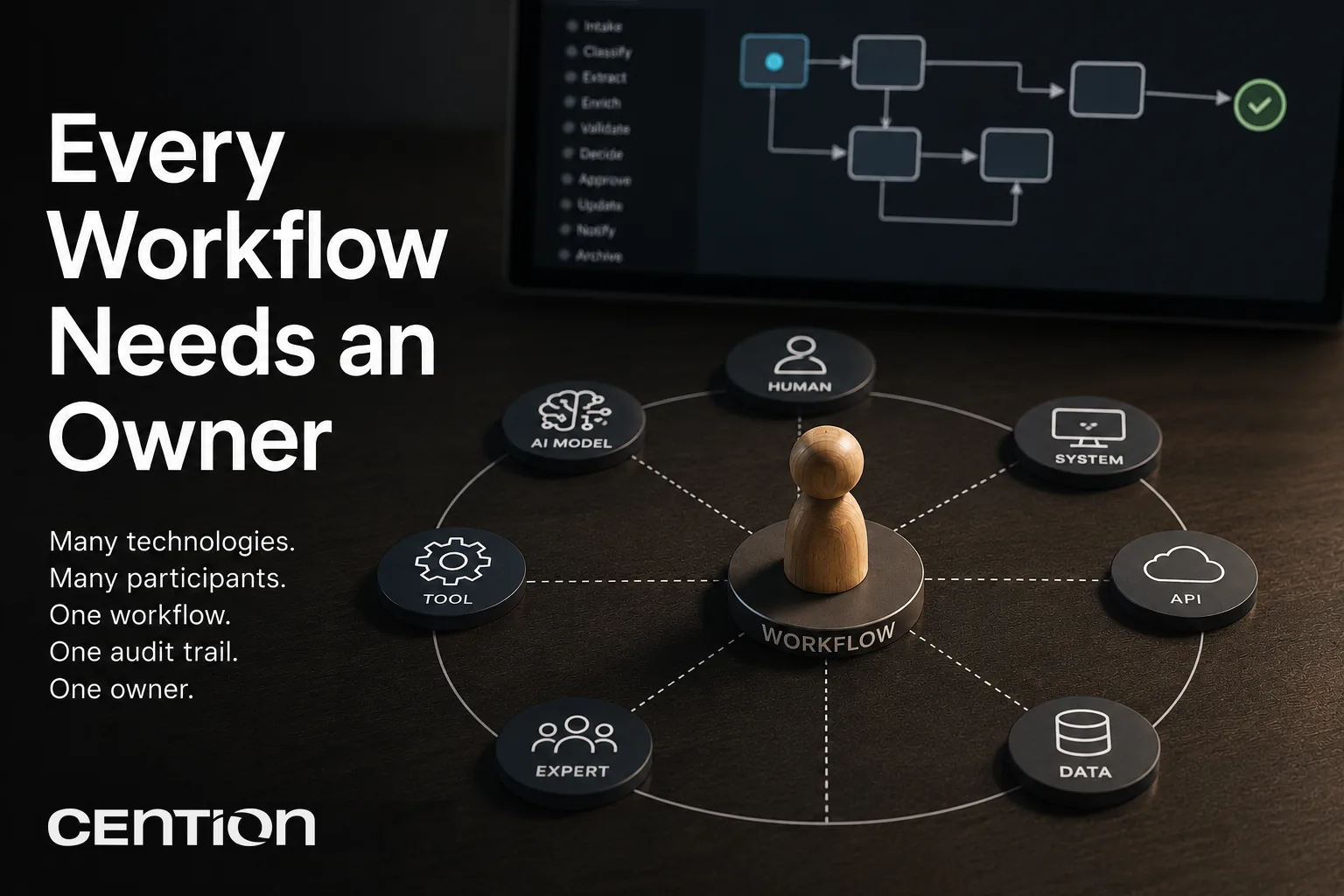
A real business workflow rarely lives inside a single product.
A customer sends an email. An API receives information from another system. An AI model classifies the request and extracts data. A workflow decides what should happen next. An ERP system provides additional information before the task is handed over to a specialist for approval. Finally, another system is updated and the customer receives a response.
Every participant may have done exactly what it was supposed to do, but when someone later asks why a decision was made or where something went wrong, the answer is often surprisingly difficult to find.
That is because many businesses have unintentionally created workflows that span multiple systems, each responsible for a small part of the process. One platform handles communication, another automation, another AI, another logging and another reporting. Individually they work well, but together they make it difficult to understand the complete journey.
From our perspective, this is becoming one of the biggest challenges in modern automation.
The participants will continue to change. Today’s AI model may be replaced next year. Business systems will be upgraded. New automation platforms will appear while others disappear. Some workflows will be fully automated while others will always require people to make decisions.
That’s perfectly fine.
What should not change is the ability to understand what happened throughout the workflow. Every organization should be able to answer simple questions such as what happened, why it happened, who or what made each decision, what happened next and what the final outcome was.
We’ve spent the last 26 years building software for managing work across communication channels, people and business systems. Along the way we’ve added workflow automation, machine learning and AI, but what we’ve learned is that the technology itself is rarely the difficult part.
The real challenge is maintaining accountability as work moves between different participants.
We believe that’s where the next generation of automation platforms needs to focus. Not on replacing every existing system, but on providing one place where workflows can be executed, traced and understood regardless of which technologies participate.
That’s why we believe every workflow needs an owner.